PlayOJO responsible gambling limits & self-exclusion guide
Learn how to use deposit limits, session controls, reality checks, time-outs and self-exclusion tools on PlayOJO in Canada so you can stay in control of your play.
I created this guide for current and future Canadian PlayOJO users who want practical help with playojo responsible gambling limits and how to self exclude playojo. Here you’ll find the main tools that help you stay in control, set safer boundaries, and manage play without pushing you toward more activity.
Best PlayOJO Offers for Canadian Players

- Easy deposit limit tools
- Reality checks available
- Time-out options
- Self-exclusion support
18+ · Use limits early · Play responsibly
- Budget-led deposit controls
- Reality check reminders
- Fast access to time-outs
- Self-exclusion for stronger protection
Practical example · 18+ · Stay in control
- Blocks account access
- Stops new deposits
- Longer-term protection
- Support can help apply it
Use when other tools are not enough · 18+
★ 4.7 / 5 — based on 1,247 verified player reviews
If you already have an account or plan to PlayOJO sign up, these tools are usually the first place to start. In this guide, I cover deposit limits, time and session controls, reality checks, time-outs, self-exclusion, and self-assessment. For Canadian players, responsible gambling Canada standards are closely tied to spending control, time awareness, and emotional balance. I’ve kept the steps simple and practical, with clear explanations and support links where they make sense.
What responsible gambling means at PlayOJO
When I review responsible play systems, I look for one thing first: whether a player can set boundaries before problems build up. At PlayOJO, responsible gambling means using self-control tools to manage money, time, and access to the account. It also means protecting vulnerable players and giving people a clear path to pause or stop play when needed.
For Canadian users, that usually comes down to transparent settings, simple limit options, and the ability to make restrictions stricter without friction. The strongest principle behind these tools is that safety comes before chasing wins or extending sessions. In practice, that means limits are there to reduce impulsive decisions, not to create more play. If you need help finding or adjusting any setting, you can always contact PlayOJO support.
Types of responsible gambling tools on PlayOJO
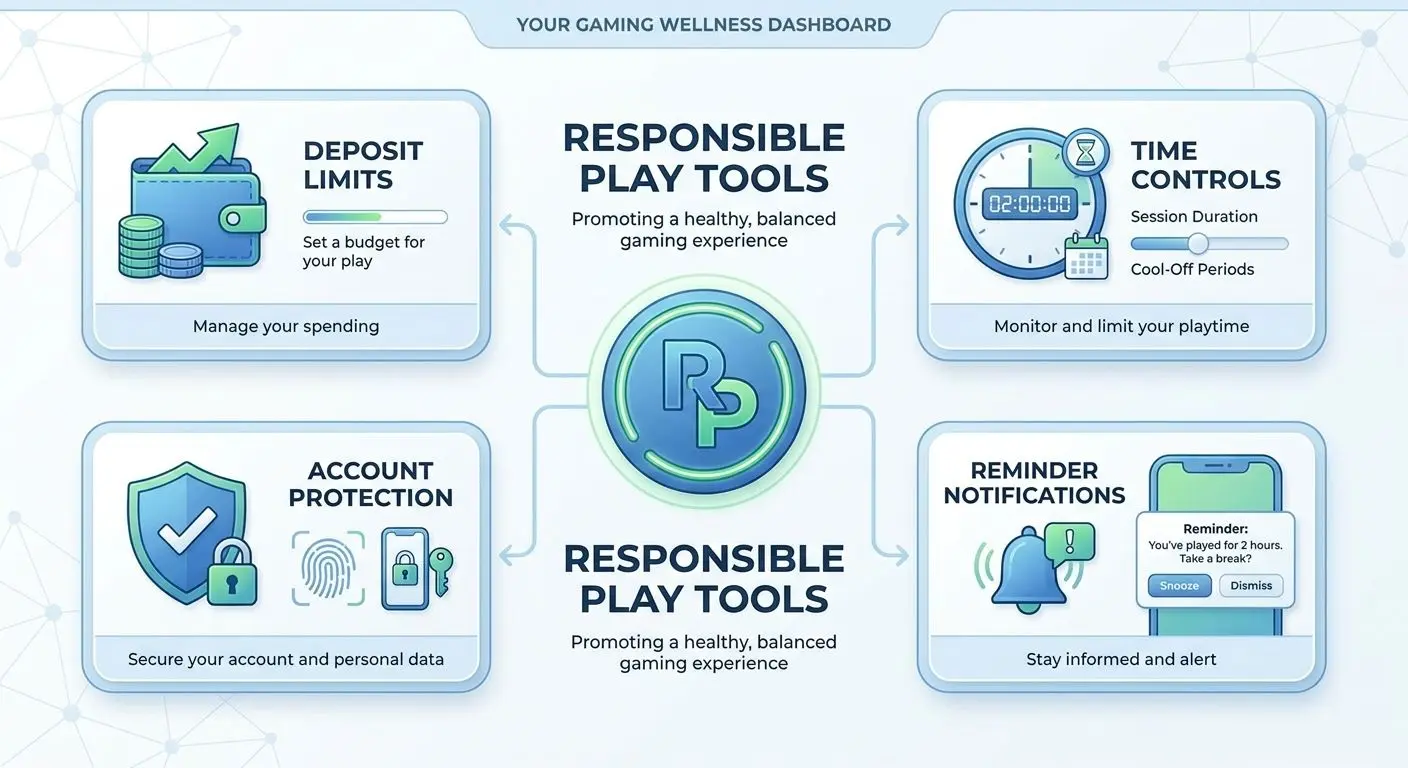
When I break down PlayOJO self exclusion options and related controls, I group them into money tools, time tools, and account access tools. They can be used on their own, but they work better in combination. In most cases, the earlier you switch them on, the easier it is to stay in control of online gambling.
- Deposit limits — cap how much money you can add over a daily, weekly, or monthly period.
- Loss limits — help control how much you are prepared to lose within a set timeframe.
- Wager limits — restrict how much total play activity can happen over a chosen period.
- Session limits — cap the length of a single play session.
- Time-outs — block access for a short cooling-off period.
- Reality checks and self-assessment — reminders and reflection tools that help you review behaviour.
How to set deposit and spending limits on PlayOJO
Deposit limits are usually the first control I recommend. They restrict how much you can add to your account over a set period, such as a day, week, or month. That makes them useful for preventing overspending and reducing impulsive top-ups during a session.
The same logic can apply to broader spending controls, including loss or play-volume limits where available. You decide the amount, choose the period, confirm the setting, and let the restriction apply before you continue.
- Log in to your PlayOJO account.
- Open the responsible gambling or account limits area.
- Choose the limit type, such as deposit or spending-related control.
- Enter the amount and the period that fits your budget.
- Confirm the setting and wait for it to take effect.
In my analysis of similar systems, stricter limits usually apply right away or quite quickly. If you try to raise a limit later, a cooling-off period is commonly required.
| Type of limit | What it controls | When it’s most useful |
|---|---|---|
| Daily deposit limit | Money added in one day | Short-term spending control |
| Weekly deposit limit | Money added across a week | Regular players with fixed weekly budgets |
| Monthly deposit limit | Money added in a month | Long-term budgeting |
| Loss limit | Total acceptable losses | Players tracking downside more closely |
| Wager limit | Total amount staked over time | Players who want to cap overall activity |
A deposit limit works best when you set it before active play starts, not after you feel pressure to spend more.
Set your PlayOJO deposit limit
Session limits, time-outs and reality checks
Time controls are useful when money is not the only issue. I often see players lose track of time first, then spend more than planned because the session keeps going. That’s where session limits, time-outs, and reality checks help in different ways.
Session limits cap the length of one play period. Time-outs pause access to the account for a temporary break. Reality checks are on-screen reminders that tell you how long you’ve been playing and, in some systems, may also highlight spending activity.
These tools are especially useful for:
- players who lose track of time;
- people who play several sessions in a row;
- users who want planned breaks during stressful periods.
You’ll usually find them in the responsible gambling or limits section of the account. From there, you can select a reminder frequency, set a session duration, or choose a temporary pause period.
| Tool | What it does | Typical duration options | Best for players who… |
|---|---|---|---|
| Session limit | Caps one playing session | Short to medium periods | Want a firm stop point |
| Time-out | Blocks access temporarily | Several days or longer short breaks | Need a cooling-off pause |
| Reality check | Sends time/spend reminders | Recurring intervals | Lose track of time |
| Daily play reminder | Flags repeated daily activity | Daily schedule based | Want regular habit checks |
Even one time-control tool can make a session easier to manage, especially if you tend to keep playing longer than planned.
How self-exclusion works on PlayOJO
Self-exclusion is the strongest control in this guide. I describe it as a voluntary protective step that blocks access to your account for a chosen period. During that time, you generally cannot play or make deposits, and account access is restricted much more firmly than with lighter tools.
This option is not a punishment. It’s there for situations where standard limits are no longer enough, or when you feel your behaviour is moving outside safe boundaries. If a player is chasing losses, hiding activity, or finding it hard to stop, self-exclusion can be the clearest reset.
The usual process is straightforward:
- Log in to your account, if you still have access.
- Go to the responsible gambling or self-exclusion section.
- Select a self-exclusion period, such as several months or longer.
- Confirm the request and review any final account notices.
In most systems I’ve analysed, self-exclusion cannot simply be reversed before the chosen period ends. If you cannot log in, the alternative path is to ask support to apply the restriction for you. During self-exclusion, access to games is blocked and promotional messages may also be reduced or stopped.
| Feature | Time-out | Self-exclusion | Impact on your account |
|---|---|---|---|
| Duration | Short break | Longer block | Stronger account restriction with self-exclusion |
| Access to games | Temporarily paused | Fully blocked | No play during the period |
| Access to deposits | Usually paused | Blocked | No new deposits while excluded |
| Reversibility | Lighter and shorter-term | Usually not cancelled early | Self-exclusion is more rigid |
| When to choose | Need a short reset | Feel out of control | Best for stronger protection |
If other tools are no longer enough, choosing self-exclusion can be a practical step to protect your wellbeing.
Self-assessment and signs you may need a break
I always suggest checking your play habits before they become difficult to manage. Self-assessment doesn’t need to be formal. In most cases, a few honest questions about time, money, mood, and daily life are enough to show whether your current limits are still working.
Ask yourself whether any of these sound familiar:
- Do you play longer than you planned?
- Do you spend money you can’t comfortably afford to lose?
- Do you try to win back losses straight away?
- Do you hide your play from family or friends?
- Do you feel stress, guilt, or frustration after a session?
- Is play affecting work, sleep, or household routines?
If you recognise several of these signs, a time-out or self-exclusion may be a better fit than small limit changes. I also recommend reviewing the PlayOJO responsible gambling policy for more detail on how account settings and related data are handled. If you still need help applying restrictions, support can guide you through the process.
Practical examples of using limits on PlayOJO
The best setup depends on how often you play and how predictable your habits are. I usually explain it through simple player profiles rather than one universal rule.
An occasional player may set a small monthly deposit limit and turn on a reality check every set number of minutes. A regular player who logs in several times a week may be better with a weekly deposit limit, a session cap, and time-outs during stressful periods. A player who feels out of control may skip lighter tools and move directly to self-exclusion for a longer break.
The point is not to find a “right” tool. The point is to combine controls that match your real behaviour.
| Player profile | Recommended tools | Goal |
|---|---|---|
| Occasional player | Monthly deposit limit, reality checks | Keep play light and predictable |
| Regular player | Weekly deposit limit, session limit, time-out | Control frequency and routine |
| Player under stress | Session reminders, time-out | Prevent longer unplanned sessions |
| Player feeling out of control | Self-exclusion | Stop account access completely for a period |
Choose the profile that feels closest to your current habits, then adjust your limits before your next session.
Staying in control: tips for safer play
My safest baseline advice is simple: set your limits before you feel the need for them. That applies to money, time, and account access. If you’re unsure whether your current settings are strict enough, move toward stronger limits rather than weaker ones.
Use this quick checklist:
- Decide your budget before you log in.
- Don’t use credit or money meant for bills and essentials.
- Set a fixed play window and stop when it ends.
- Avoid playing when stressed, tired, or after drinking.
- Review your limits regularly and tighten them if needed.
- Use reality checks if you tend to lose track of time.
- Ask support for help with settings if anything is unclear.

For updates or educational posts, PlayOJO may also share responsible play content through social channels such as https://facebook.com/playojo, https://instagram.com/playojo, https://x.com/PlayOJO, and https://youtube.com/@PlayOJO.
Popular Slots at PlayOJO UK












About the author
I’m Tim Mirroman, and I analyse the online gaming market with a focus on clear, usable information for Canadian readers. For this page, I reviewed PlayOJO limit tools, common responsible play practices used by major operators, standard approaches to time-outs and self-exclusion, and the need Canadian players have for plain-language guidance. You can find me on LinkedIn: https://www.linkedin.com/in/tim-mirroman-87b3a4237/
My main takeaway is straightforward: limits work better when they are set early, and they work even better when combined. Deposit controls, time reminders, and session boundaries cover different risks. When play stops feeling manageable or enjoyable, self-exclusion is often the most effective next step. My advice is to begin with firm limits and not hesitate to use stronger restrictions if your habits change.


FAQ: PlayOJO responsible gambling limits & self-exclusion
How do I set deposit limits on PlayOJO?
Log in to your account, open the responsible gambling or limits area, choose a deposit limit, set the amount and the time period, then confirm the change. In most systems, lowering limits applies quickly, while increasing them may take longer because of a waiting or cooling-off process.
How can I self-exclude from PlayOJO if I feel out of control?
Go to the self-exclusion section in your account, choose the exclusion period, and confirm the request. This is a serious restriction and is usually not cancelled immediately. If you can’t access your account, you should ask support to apply the exclusion on your behalf.
What is the difference between a time-out and self-exclusion on PlayOJO?
A time-out is a shorter temporary pause, while self-exclusion is a stronger and longer restriction. Time-outs are better for short breaks and cooling off. Self-exclusion is more suitable when you need full account blocking and a firmer barrier against returning too soon.
Can I change or remove my responsible gambling limits later?
Usually, yes, but the process depends on whether you are making the limit stricter or looser. Stricter settings often take effect fast. Reducing the level of protection, such as raising a cap or shortening a restriction, commonly comes with a waiting period.
What if I still have questions about PlayOJO’s responsible gambling tools?
If anything is unclear, the best next step is to contact PlayOJO support and ask for help with account settings, limits, time-outs, or self-exclusion. You can also review the site’s responsible play and privacy information to understand how these controls are managed.
Using limits is a sign of responsible play and self-awareness, not weakness.